
Payer to Payer API
Payer to Payer Application Programming Interface
A Payer to Payer API is a secure, standardized method for health insurance plans to exchange member data with one another when a member switches health plans.
Technical Details
- Required by CMS (CMS Interoperability and Prior Authorization Final Rule).
- Uses FHIR (Fast Healthcare Interoperability Resources).
- Payers must provide plain-language educational resources to patients that explain the benefits of the API.
- Consent type: Opt-in.
- Date Required By: January 1, 2027.
Goal
To create a more seamless transfer of patient information, ensuring continuity of care and reducing administrative burden.
Explanation
The healthcare industry is siloed. It is hard and expensive to obtain a holistic view of a patient’s health information. The silos ultimately prevent people from receiving the best possible care. The payer-to-payer API seeks to connect siloed patient information together.
The API allows a payer to request a patient’s data from their previous payer, with the member’s consent. A payer must be able to receive data from other payers up to the previous 5 years the patient was insured by them.
A payer, with the consent of the patient, will request data from previous insurance companies (within the last 5 years of the request date). The previous insurance companies will send the requested data to the new payer. Once received, data must be incorporated into the payer’s patient record. Once incorporated, it must be accessible via the Patient Access, Provider Access, and Payer-to-Payer APIs as appropriate.
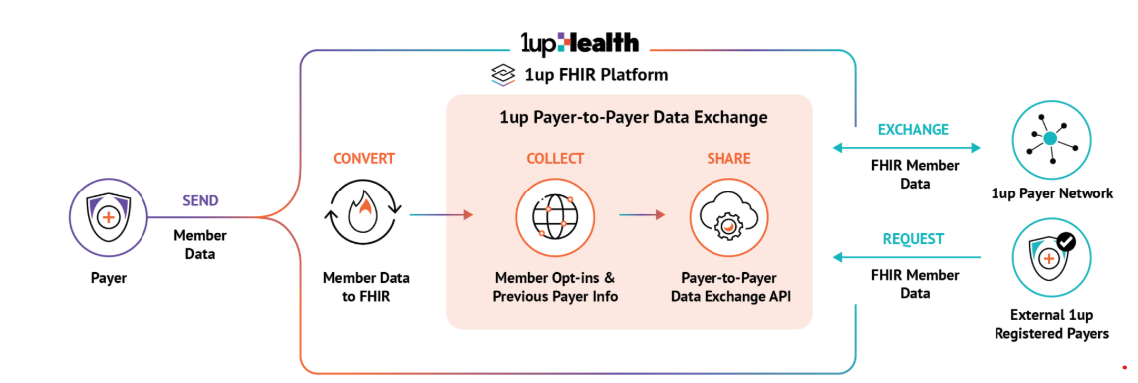
Payers are required to be able to send, receive, and incorporate enrollee data from the period they were covered by a payer for up to five years after coverage ends. A payer also needs to be able to send member data during, and up to five years, after a patient’s coverage ends to new payers that insure the patient.
Who is Impacted?
Not all insurance companies are required to participate in the payer-to-payer APIs. The following are required to participate: Medicare Advantage (MA) organizations, Medicaid managed care plans, Children’s Health Insurance Program (CHIP) state agencies and managed care entities, qualified health plan (QHP) issuers on the federally-facilitated exchanges (FEE). Other insurance companies may participate as they see fit.
What’s included in the data?
The data that is required to be transferred during the payer-to-payer API includes: clinical history; claims; authorizations, Transmission of the full health record is not required but encouraged.
Claims data excludes provider remittances and enrollee cost-sharing information.
Prior authorization information must include details about existing or past prior authorizations, excluding those for drugs.
Patient data with a date of service within five years of the data transfer request are required. Data outside of the five-year window is not required to be transmitted.
For patients with coverage from more than one insurer, payers must exchange data quarterly to maintain up-to-date records.
Benefits of the Payer-to-Payer API
- Enhanced member satisfaction- ensures that critical patient information is seamlessly transferred, empowering members with continuity of care, avoiding duplication of tests and treatments. Reduces complaints and churn rates.
- Reduction in administrative burden- by automating data exchange, the API will alleviate administrative workloads. Payers save time and reduce costs associated with faxing, phone calls, and manual data entry and improves accuracy and operational efficiency.
- Support for value-based care models- Ensures that new payers have access to the patient’s recent history, enabling effective management of chronic conditions, care planning and coordination.
- Compliance with CMS standards- ensures payers avoid penalties