
Interoperability
Diagram showing interoperability flow
What is interoperability?
According to the Healthcare Information and Management Systems Society (HIMSS), interoperability means that different information systems, devices, and applications can work together to share and use data. This cooperation happens smoothly within and across different organizations, regions, and countries, ensuring that information is easily accessible and can help improve the health of people everywhere.
This ability of systems allows for data to be accessed and shared appropriately and securely across different points of care such as hospitals, community organizations that provide care for the social determinants of health[1], and specialists that help with specific care.
[1] Social Determinants of Health are non-medical factors that affect health outcomes. Social Determinants of Health | Public Health Gateway | CDC
Why is it important?
Interoperability already exists within certain systems of healthcare such as doctors, hospitals and pharmacies. By expanding and bettering the interoperability of healthcare systems, not only does it increase efficiency but affordability of services.
Diagram showing benefits of healthcare interoperability.
Benefits of Interoperability
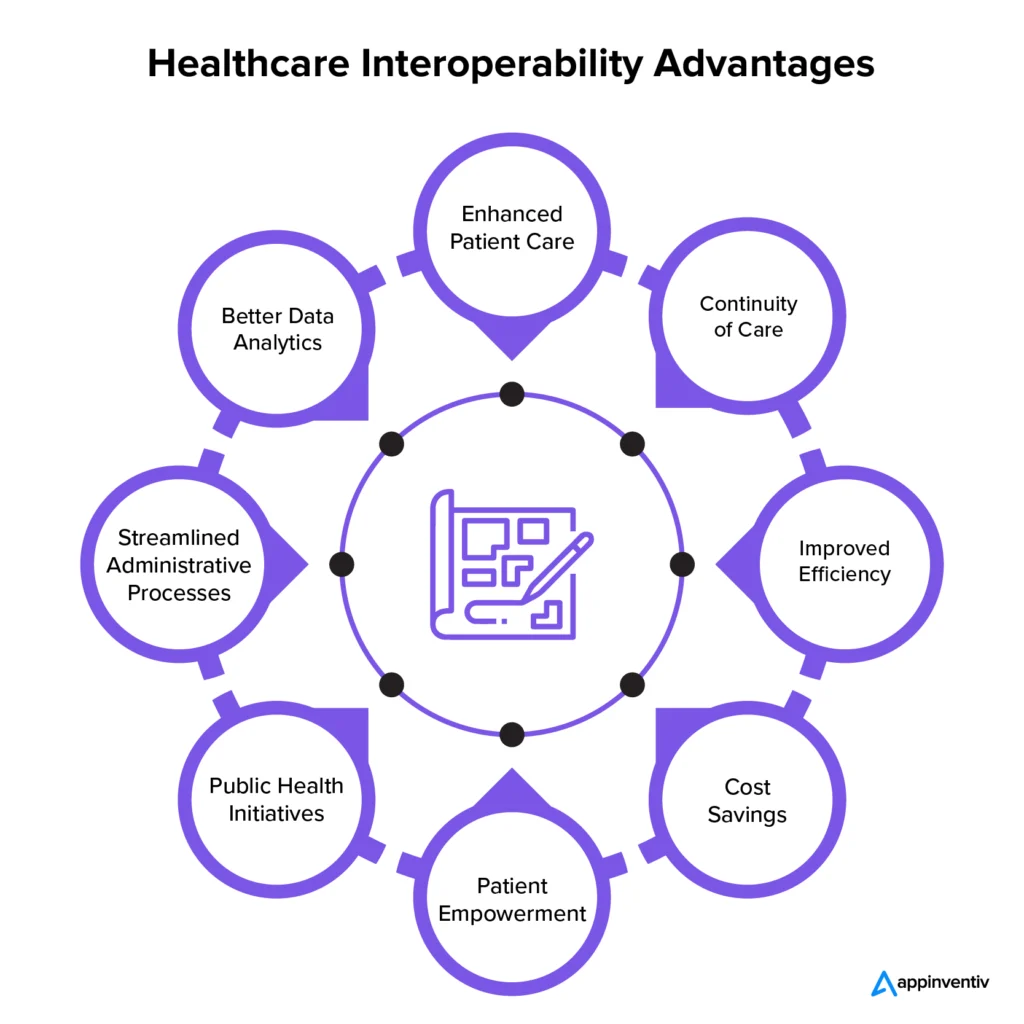
- Care coordination: Care coordination often involves a variety of stakeholders, including patients, caregivers and care teams across settings in the management of a patient’s health. This process requires data movement across platforms and among service providers in real time to successfully manage care.
- Improving business and administrative processes: Having access to health information can eliminate time-consuming tasks within a health system, including processing of intake information, coordination across care teams, and reporting patients’ needs.
- Increased patient safety and satisfaction: It is important to have a full picture of a patient’s health through patient’s medical history, preferences, and past encounters. This can help avoid duplicate testing, reduce adverse events, inform care decisions, and conduct appropriate follow-up.
- Value-based care: Population-level data analysis is crucial for health systems to manage high-risk patient populations and coordinate care needs, enabling better risk analysis and cost-effective care. Incorporating non-traditional health data, such as social determinants of health, into patient records allows health systems to proactively identify health risks and work towards positive outcomes.
Tips for selecting a Third-Party Digital Application
Third party applications can be accessed through the App Store. Always review the apps privacy policy and Terms of Use/Terms of Service before agreeing to use an app.
Things to consider:
- What data will this app collect? Will this app collect non-health care data from my device, such as my location?
- Will my data be stored in a de-identified or anonymized form?
- How will this app use my data?
- Will this app disclose my data to third parties?
- Will this app share my data for any reason, such as advertising or research? If so, with whom? For what purpose?
- How can I limit this app’s use and disclosure of my data?
- What security measures does this app use to protect my data?
- What impact could sharing my data with this app have on others, such as my family members?
- How can I access my data and correct inaccuracies in data retrieved by this app?
- Does this app have a process for collecting and responding to user complaints?
- If I no longer want to use this app, or if I no longer want this app to have access to my data, how do I terminate the app’s access to my data?
- How does this app inform users of changes that could affect its privacy practices?
List of Applications approved for Michigan Health IT
Guava
Guava allows users to securely manage their health by storing all health records in one convenient place. It allows users to access various sources of information including lab results, medications, doctors’ notes and more.
OneRecord
This combines health records from different healthcare providers into a single view enabling users to see, aggregate, and share healthcare data with people or organizations they trust.
Mpowered Health
Mpowered Health connects consumers and healthcare enterprises to simplify access to healthcare. The app includes features such as the ability to shop for coverage, share medical records and access records such as lab results, claims etc.
MaxMDApp
MaxMD is a patient-facing application that allows communication between payers, providers and patients to provide comprehensive access to health information across systems.
CommonHealth
Provides access to the records for Android users, supports SMART Health Card digital vaccine records, and can connect to over 700 data sources, including major health institutions.
b.Well Connected Health
b.well unifies healthcare data from various sources into one FHIR platform. It enables users to access health data, receive real time personalized insights, recommendations, and much more.
MyHB/myHP
myHB/myHP is an application available to members of Michigan Medicaid, Healthy Michigan Plan, MIChild, and Children’s Special Health Care Services. The application allows members to access Medicaid information including features to view healthcare coverage, find a doctor, check immunization records, etc.
HealthDataClarity
HealthDataClarity is an application that allows members to access and download health records, connected to 300+ health plans.
Flexpa-MDHHS
Flexpa is a single secure platform that connects users to 300+ health plans enabling access to claims data.
Care Convene
Care Convene is a digital platform designed to enhance patient-provider communication offering care, coordination and symptom management and reporting.
CareConvene – CareConvene offers more ways to engage patients than ever before!